
|
I’m developing a thesis about long novels. It is that most of them could be improved with a recklessly expansive edit. This certainly applies to the two huge Dostoevsky works I (almost) read last year, after which it felt like a natural transition to move onto his fellow Russian heavyweight Leo Tolstoy – another writer famed for length and complexity. After a few weeks spent convalescing from my experiences with The Idiot (now returned
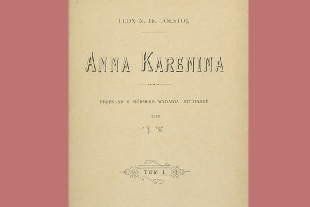
to my shelves, unfinished) I picked up Anna Karenina and settled in for another long
haul: 820 pages in the 2016 Oxford World’s Classics edition. So much of a long haul,
in fact, that in 2001 a Moscow publisher released a modernized version, which reduced
Tolstoy’s 1878 masterpiece to an 80- Amusing as this is, I hope no- Tolstoy was born in September 1828, just under seven years after Dostoevsky. Sadly, for posterity the two writers never met, despite having a mutual friend in the philosopher Nikolai Strakhov, with whom they both corresponded. But they did follow and admire each other’s work. Dostoevsky thought especially highly of Anna Karenina, once describing it as ‘sheer perfection as a work of art.’ My only criticism of that judgement is that it doesn’t go far enough. Tolstoy is just as concerned with ideas as Dostoevsky and devotes lengthy sections of Anna Karenina to the political and philosophical issues of his day; but unlike his slightly older contemporary, he never forgets that his main task is to tell a story. Dostoevsky’s major fictional works – especially The Brothers Karamazov – could be converted into philosophical tracts without losing too much; Tolstoy’s would be ruined. There is not a dull paragraph in Anna Karenina. Tolstoy’s prose (especially in the brilliant English translation by Rosamund
|
|
|
Bartlett) is fluid and unaffected, almost conversational. His characters are complex, autonomous human beings. The 1870s Russia in which they live is depicted with cinematic vividness. The set pieces are viscerally powerful. One death scene made me so aware of my own body and mortality that I had to pace around the room while reading: I was too stimulated to sit still. The work’s vast narrative structure is held together by Tolstoy’s infallible instinct for pacing and development. On the very first page, Tolstoy immerses you in the chaotic family life of Anna’s
brother Stepan Arkadyich and his wife Dolly, just after the former’s affair with
their governess has been discovered. A much- Even when nothing much seems to be happening – Levin pottering around his estate, for example, or aristocrats gossiping at the snobbish soirees of Moscow and St. Petersburg – Tolstoy is piling on texture and detail, deepening his characters. The ending, which comes around fifty pages after the novel’s climatic event, is as flawlessly executed as everything else. Anna Karenina is that rarest of things: a very long book that would in no way be improved for being shorter. I was nostalgic for the experience of reading it long before I reached the final pages. I have too many favourite moments to discuss here, but this is one. Fairly late on
in the drama, a tortured Anna asks her beloved sister- |






 CONTACT
 SELECTED ARTICLES