|
“Spain is and will be forever the land of Christian people’. These are not, as you
might think, the words of a marauding conquistador, but of a spokesperson for Spain’s
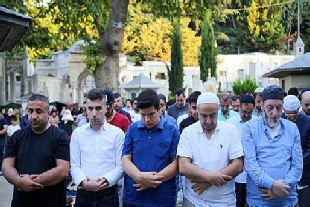
right wing Vox party. They were posted on X this week, in response to a ban on Muslim
religious celebrations imposed in the southeastern town of Jumilla.
The first prohibition of its kind in Spain, it was proposed by Jumilla’s Conservative
administration and passed with Vox’s (surprising) abstention. It bans the use of
municipal facilities such as sports halls for ‘religious, cultural or social activities
alien to our identity unless organised by the local authority’. This senseless legislation
means that the 7.5% of Jumilla’s 27,000 citizens who come from Muslim countries will
no longer be able to publicly celebrate Islam’s two main festivals - Eid al-Fitr,
which marks the end of Ramadan in March, and Eid al-Adha, the Feast of Sacrifice,
held in early June.
umilla’s ban is a knee-jerk reaction to anti-migrant riots in Torre-Pacheco, a town
70 miles to the south, in which approximately 18% of the 35,000 residents are of
African origin. On July 9th, a local pensioner was allegedly beaten up by three Moroccan
men, prompting two nights of violent protests. Locals armed with baseball bats reportedly
took to the streets, responding to calls on social media by right wing groups to
target North African migrants. A kebab shop was vandalised and fourteen people were
arrested.
Reacting to the riots in Torre-Pacheco and Jumilla’s ban on Muslim celebrations,
Mounir Benjelloun Andaloussi Azhari, president of the Spanish Federation of Islamic
Organisations, said he was ‘rather surprised by what’s happening in Spain. For the
first time in 30 years I feel afraid’. Azhari accused Jumilla’s government of ‘going
after’ Muslims and called the ban ‘Islamophobic and discriminatory’.
Reacting to the riots in Torre-Pacheco and Jumilla’s ban on Muslim celebrations,
Mounir Benjelloun Andaloussi Azhari, president of the Spanish Federation of Islamic
Organisations, said he was ‘rather surprised by what’s happening in Spain. For the
first time in 30 years I feel afraid’. Azhari accused Jumilla’s government of ‘going
after’ Muslims and called the ban ‘Islamophobic and discriminatory’.
The prohibition deserves condemnation - and rapid repeal - for several reasons. First,
it is almost certainly unconstitutional. According to Article 16 of the Spanish Constitution,
‘freedom of ideology, religion and worship of individuals and communities is guaranteed,
with no other restriction on their expression than may be necessary to maintain public
order’. The same section
|
|
|
also states that ‘no religion [in Spain] shall have a state character’ and that ‘public
authorities shall take into account the religious beliefs of Spanish society’. Although
56.1% of Spaniards identify as Catholic, Catholicism is not Spain’s official religion.
Spain has no state religion; rather, it is committed to the protection of religious
plurality.
Secondly, the prohibition panders to the violent racism seen on the streets of Torre-Pacheco.
Instead of sending a message of solidarity to Spanish Muslims after those disturbing
events, Jumilla’s administration has chosen to make them feel even more unwelcome.
This would be deplorable in any democracy; but it is especially sad to see in a country
whose history is defined by centuries of harmonious co-existence between Jews, Christians
and Muslims.
Which brings us to the third and most serious criticism of Jumilla’s ban - that it
relies on an indefensible notion of national identity. As Juana Guardiola, a former
Socialist mayor of Jumilla, has rightly asked, ‘What do they mean by identity? And
what about the centuries of Muslim legacy here?’
Guardiola refers to a period of Spanish history that lasted from the early-eighth
to late fifteenth centuries. For almost eight hundred years, Al Andaluz, as Islamic
Spain was known, thrived under Muslim rule. In the tenth and eleventh centuries,
administered by the powerful Caliphate of Cordoba, it was the intellectual capital
of the West - a centre of pioneering advances in medicine, philosophy and science.
Jews, Christians and Muslims collaborated to make Al Andaluz the most dynamic and
progressive country in medieval Europe.
The legacy of this remarkable era is visible all over Spain, especially in the southern
region of Andalusia - from Granada’s Arabic markets and Alhambra fortress, to Cordoba’s
Mezquita-Catedral, a medieval Mosque with a Renaissance Catholic nave at its centre.
Jumilla itself, as Yumil-la, was under Islamic rule from the early 700s until the
mid 1200s, when Christian forces seized control (to anyone wanting to know more about
this fascinating period, I highly recommend Maria Rosa Menocal’s Ornament of the
World: How Muslims, Jews and Christians Created a Culture of Tolerance in Medieval
Spain).
The baying thugs who roamed the streets of Torre-Pacheco last month are not representative
of Spain’s modern identity; nor is the local government that wants to keep Muslims
behind closed doors. Spain is, and will forever be, a land of many religions, defined
by its rich Islamic, Jewish and Christian heritages. Anything else is disinformation.
|







 CONTACT