|
In very different ways, these two books look at monster tales and supernatural folklore, examining what our most fantastical stories reveal about the human societies that have invented them. The travel writer Nicholas Jubber, whose last book, The Fairy Tellers: A journey into the secret history of fairy tales (2022), covered similar territory, travels to the countries associated with each of the monsters he studies. He also participates in the local rituals that keep their legends alive, from a festival dedicated to Bolster the Giant in Cornwall to raucous celebrations of the rougarou (a kind of werewolf) in Louisiana. Intriguingly, Jubber hints that monster legends have helped him in a “long- The earliest monsters were often also regarded as gods – beings that inspired devotion
as well as fear. At sea, Bell points out, this provided ancient mariners with a way
of “psychologizing” the weather, which was viewed as a manifestation of divine mood.
Although belief in these gods had disappeared by the eighteenth century, Christian
mariners continued to interpret storms as punishment for their misdemeanours –and,
like many workers involved in dangerous occupations, they were a superstitious crowd.
Throughout the pre- Jubber suggests that monsters and gods slowly separated as human beings’ confidence
in their ability to master nature increased; over time, gods became more human- Jubber seeks out fear and darkness. He spends the night in an abandoned water mill near the Serbian village of Zarožje, the of one of the earliest vampire legends. (The first began circulating in the 1670s, and was of Czech origin.) In a tale dating from the nineteenth century, Sava Savanović was said to be on the rampage in Zarožje, until one villager was brave enough to open his coffin, douse him with holy water and ram a stake into his chest. During a sleepless night in Savanović’s lair, Jubber never really believes that a vampire is lurking in the dark, but the “sounds of nature scraped on [his] nerves” and he couldn’t shake the feeling that something might happen. “You think you’re rational”, he writes, “but your incredulity will be tested when you’re alone in the dark.” The vampire is one of the few monsters featured in these works to have made the transition
from localized folklore to world literature. Jubber claims that John Polidori’s The
Vampyre (1819) – the first vampire tale to be published in English – and Bram Stoker’s
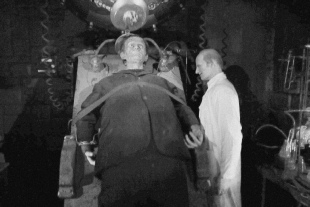
Dracula (1897) created the “Byronic, upper- Polidori, who briefly worked as Lord Byron’s physician, also played a supporting role in the creation of the world’s most famous literary monster. In the summer of 1816, he joined Byron and the young writer Mary Godwin, as well as Godwin’s future husband, the poet Percy Shelley, and her stepsister Claire Clairmont, on a trip to Lake Geneva. As this literary quintet sheltered in their villa from the awful weather, Byron suggested that they each write a ghost story. An elaborated version of Mary’s contribution was published two years later as Frankenstein – a novel that, according to Jubber “showed we don’t need the gods or nature to punish us with evil spirits” because “we’re pretty damn good at tormenting ourselves”. But Frankenstein’s creature isn’t just frightening: he is sad and lonely, yearning for love and acceptance. As an outcast, a victim of human hubris, he encourages pity compassion, despite his murderous rampages. Many of our monsters and mythical creations have this dual nature – of being scary
but relatable, or masking a lethal nature under an alluring exterior. Take the mermaid,
a nautical trope as old as human civilization. Bell claims that Atargatis, an ancient
Syrian fertility goddess, “offers one of the earliest divine models for the mermaid”,
which for eighteenth- It was said that sailors unable to resist a mermaid’s beauty or seductive song were lured into the depths, never to return. Mermaids could also curse towns, control the weather and bring both good and bad luck to ships. But they weren’t pure folklore: experienced sailors reported sightings well into the nineteenth century. In 1823, six fishermen in the Shetlandsclaimed to have caught a mermaid three feet long, with the body of a human |
|
|
and a head like a monkey’s, covered with stiff bristles. Sceptics reasoned that it was probably some kind of seal, but the fishermen were adamant that they could tell the difference. Still, there was presumably no danger of plunging after such a creature in the hope of otherworldly pleasures: “The ‘real’ mermaid”, Bell notes drolly, “frequently failed to live up to the beautiful idea of myth. Unlike Scottish mermaids, which seem to have become extinct, Mexico’s most iconic
ghost is very much alive. According to one version of the legend, La Llorona (“The
Wailing Woman”) is the tortured spirit of a native Mexican woman named La Malinche,
who had two children with a Spanish conquistador named Hernan Cortes, as well as
assisting him in the seizure of Tenochtitlan (as Mexico City was then called) from
the Aztecs in 1521. When Cortes refused to marry her, she drowned their children
in jealous rage before drowning herself. Her grief- This interpretation of the La Llorona legend has persisted partly because of its
historical significance. Many Mexicans believe that La Malinche “betrayed” her nation
by aiding its Spanish conquerors. Yet she is also regarded as the mother of the mestizo,
or mixed, Mexican nation that exists today. Jubber suggests that her tale also admits
of a feminist interpretation for the twenty- In Morocco, Jubber tracks the djinn – - expert in the Qur’an and unseen spirits. This might raise eyebrows among nonreligious readers sceptical of “alternative” treatments; but Jubber empathizes with a Moroccan woman who tells him she was possessed by a djinn for two decades before freeing herself through ritual trance: I thought of [the] ... times I had felt ashamed to vocalise the darkness inside me … Yes, if there was a ritual that might solve it all, if it was endorsed or encouraged by the people around me, then … why not? On Mount Zerhoun, in the desert north of Meknes, he witnesses a fringe celebration, disapproved of by many orthodox Muslims, in which a young man slashes at his face with a knife until his hair is a “matted black gel”. Such behaviour would be considered to require the urgent attention of a psychiatrist in most European countries; but within his community, the ritual’s bloodied protagonist is thought to have achieved a state of trance known as hal. Such examples push against the limits of cultural relativism, testing our prejudices. For Jubber, that’s travel at its best: “Is there any point in travelling if we limit ourselves to the world we understand?” Bell’s research is presented with all the scholarly hallmarks one would expect, including
caveats about the reliability of sources and references to other academics; but it
lacks the living human context that gives Jubber’s book edge and vitality. Both authors,
however, write insightfully about the Anthropocene; popularized in the early 2000s,
the term designates the geological epoch defined by humanity’s impact. Now, writes
Bell, “we have become the monsters”. Humans are the twenty- Despite these apocalyptic pronouncements, both writers end on a note of optimism. The explosion in popularity of cinematic monsters over the past few decades, says Nicholas Jubber, has brought people together again; in a secular, scientific age, monster stories meet the need for transcendental myths once satisfied by religion. For Karl Bell, ancient mariners’ tales and practices can “teach us how to confront our own environmental fears as we attempt to navigate the turbulent currents of an uncertain future”. In the meantime, any sceptics are challenged to spend a night in that Serbian mill. |