|
If I were a doctor specialising in alternative treatments, and someone came to me
feeling depressed, I wouldn’t send them offwith a herb-based elixir or a bunch of
St John’s Wort. I wouldn’t cleanse their chakras or refer them to an acupuncturist.
I’d send them offto Málaga’s annual fair, which this year runs from August 16th to
the 23rd.
Summer in Andalusia is feria season - the best cure that I know of for a bout of
the blues. Usually lasting three or four days, or an entire week in the regional
capitals, ferias are occasions of pure alegria (joy) and inclusivity. Happiness is
taken very seriously in Spain, especially in Andalusia, and nowhere is this more
evident than at a summer fair (Spaniards from the north like to say that all Andalusians
are idle hedonists, more likely to be found in a bar than at work). Although tremendous
amounts of alcohol are consumed, I have never witnessed any anti-social behaviour
in the decade that I’ve been attending them: no fights or public vomiting, no sexual
aggression, not even a drunken argument. Unlike Brits, Spaniards tend not to actively
seek oblivion through alcohol; it is a social lubricant, not the activity around
which ferias revolve. Families can be seen pushing prams well past midnight. Teenagers
mostly carry cans of Monster, not cider or lager.
One of my favourite village ferias takes place in mid-August in Pastelero, a mountain
hamlet near Málaga with a population of around 500. Everyone gathers along the single
road to feast on paella, which is cooked outdoors in a pan the size of a tractor
wheel. Farmers ride around on horseback, sipping sherry in the saddle. At ferias
of all sizes, but especially at the larger ones, you’ll wander amongst women wearing
intricately-designed flamenco dresses and scarlet flowers pinned to their hair. At
the biggest fairs, hundreds of marquees (casetas) are erected on a fairground (recinto),
where revellers drink, eat and dance. I particularly love the colours of the feria:
the dusty yellow of the recinto floor; the multi-coloured paper lanterns strung between
white casetas; the childish blue of the summer sky; explosions of red on flamenco
dresses and the sleek black coats of Andalusian horses (pura raza Española), one
of the world’s finest breeds.
Most of these celebrations started out as livestock fairs in the Middle Ages. Ranchers
would come to town to sell their cattle,
|
|
|
and because in Spain every transaction is also a social occasion, vendors would wander
amongst them offering refreshments. These boozy trade fairs steadily expanded over
the centuries to become the huge events they are today. Seville’s Feria de Abril,
which launches the season two weeks after Easter, is the largest: over one thousand
casetas spread over a recinto several times the size of Pastelero (the downside for
visitors is that only a handful are open to the public). The major ferias also feature
several bullfights - Málaga will hold seven this month, starring the biggest names
in the business. Other seasonal highlights include Jerez de la Frontera’s lovely
Feria del Caballo (Horse Fair) in May and Ronda’s Feria de Pedro Romero, held in
early September and named after the town’s famous 18th century bullfighter. Here,
the partying happens amidst some of southern Spain’s most dramatic scenery.
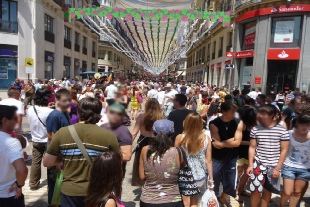
Málaga’s fair is unique (and probably my favourite) for also hosting a giant street
party in the Old Town during the day, before those with enough youth or stamina jump
on a bus to the recinto for the night session. The best way to experience the daytime
celebrations - and the advice I would give to my imaginary depressed patient - is
to do as everyone else does.
Go to the nearest Tabac and buy a bottle of the feria’s signature wine, a sweet white
called Cartojal, made from Málaga’s moscatel grape. As you swig or sip (you’ll receive
a little paper cup with the wine), meander up the Old Town’s main artery, Calle Marqués
de Larios. Watch the street entertainers; admire the women in their long, colourful
dresses; linger on the palm-lined Plaza de la Constitución, where live music will
make your body vibrate. Continue up Calle Granada and stop in a couple of the crowded
bars for a tapa and small beer (caña). Repeat until your senses can’t take any more.
The heat, the noise, the colours and wine will purge you of tension and stress, filling
your whole being until there’s no room for misery. I would confidently expect my
patient to come back from Málaga a different person, still fizzing with energy and
Cartojal - or to simply not return at all.
|







 CONTACT