“I’d like you all to note that I am not wearing a tie,” Pedro Sánchez jokingly told a news conference in July 2022, as a heatwave ravaged Europe. With a levity that was no doubt carefully rehearsed, Spain’s Socialist prime minister asserted that this simple sartorial hack meant “that we can all save from an energy point of view.” The extent to which tieless office workers kept CO2 emissions down was harder to measure than heat-related mortalities, of which Spain recorded 11,324 in 2022. Across Europe as a whole, that figure rose to over 61,000.


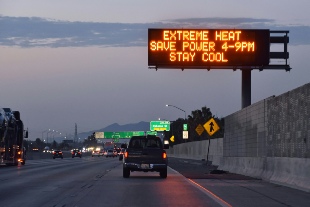
Four years on, heatwaves have become a regular feature of summers on the world’s fastest-warming continent (Europe is heating up at double the global average). June 2026 was the most extreme on record, and contributed to as many as 20,000 deaths, according to a report in the New Scientist. Schools closed, customers fought over bargain A/C units, nuclear reactors were taken offline, and cultural events were canceled. Spain and France each posted around 1,000 heat-related mortalities, while typically cooler countries such as Poland, Germany, and the Czech Republic recorded temperatures above 40 °C (104 °F). Even the UK, where BBQs are liable to be rained off at any time of year, experienced its hottest-ever June, with temperatures reaching 37.7 °C (99.9 °F). According to scientists at World Weather Attribution, a heatwave similar to the one seen in Europe last month would have been around 3.5 °C cooler in June 1976.


European heatwaves have brought with them an associated political phenomenon. Every summer, the continent’s politicians debate global warming along the same old ideological divisions: center-right ministers advocating greater flexibility in Brussels’s green agenda (many of them dubbed “far-right” monsters by the bloc’s liberal elite) battle the EU Commission and leaders of center-left governments. But by deepening polarization and preventing constructive problem-solving, these rows have become part of the problem.


It’s not just politicians who are divided by mutual antagonism over global warming. A 2023 study found climate change and immigration to be the two most polarizing issues in Europe. It revealed that “Those individuals who think that the policies targeting climate change are ‘far from sufficient’ are significantly more affectively polarized than others”—meaning that they “hold a significantly more negative attitude toward people who hold the opposing opinion than is true the other way around.” Overall, people on the left registered the highest levels of affective polarization—i.e., are the angriest. Polarization amongst European electorates, one suspects, is both cause and effect of division at the political level: by pushing politicians into extreme positions, it reinforces the role of emotion in this debate, rendering nuanced, rational discussion all but impossible.


The position of the EU Commission broadly is that climate adaptation needn’t compromise long-term mitigation, as long as renewables are prioritized over fossil fuels. In reality, though, EU member states have hardly any room for maneuver: like the goals ratified in the Paris Agreement, signed by 195 countries in 2015, the bloc’s carbon-reduction targets are legally binding. A series of UN climate talks held in Bonn, Germany, last month ended in stalemate, but the concluding statement still said: “[W]e simply cannot afford to re-open previous decisions, to renegotiate existing targets, or to backslide.” This attitude is reflected by the last EU budget, in which 72% of climate-related expenditure went to reducing greenhouse gases, 18% to adaptation measures, and just 9% to both. If the annual heatwaves prove anything, it is that the last two figures need to be significantly higher.


This inflexibility over climate goals invites comparison to revolutionary movements aiming for political Utopia. The suffering required to create heaven on earth—in this case achievable by 2050—must be stoically accepted, if not actively welcomed. Any price is worth paying in the march toward perfection. As one commentator recently wrote in The Spectator:


[Climate activists] believe that suffering is regarded as a necessary ordeal to awaken citizens to the coming apocalypse of climate change. Enduring the cruel afflictions of extreme heat is an expiatory ritual that expunges the sins of over-consumption in a society addicted to fossil fuels and nuclear power.


This summer, the debate triggered by European heatwaves went Transatlantic. When American tourists and journalists mocked Europe for its aversion to A/C, the TV personality and leftist deputy mayor of Paris Audrey Pulvar responded by blaming America for the heat:


As the second-largest emitter of greenhouse gas emissions in the world [the US accounts for about 15% of the total, after China at 30%], you bear a significant amount of responsibility for global warming and the consequences we, in France, are experiencing. Your cities, which are 90 per cent air conditioned, are not unrelated to this.


It’s not hard to detect a vestige of historic European superiority toward the US in these remarks. Air-conditioning, Pulvar seemed to imply, is not only polluting the planet—it’s so obvious, so unsophisticated. Meanwhile, French citizens, stylishly sweltering in their 17th- and 18th-century houses, have taken to painting their windows with chalk to deflect the heat. When out and about, they shelter in cutting-edge public buildings that keep people cool with innovative ventilation solutions, rather than dirty A/C units. This is the EU dream: keep cool and save the planet.


Take, for example, the train station in Nantes, northwest France. In 2020, a new glass mezzanine designed by celebrated French architect Rudy Ricciotti was unveiled. This €37.5 million ($42.8 million) glass-roofed structure stretches for 165 meters above the tracks, and was supposed to be thermally self-regulating—i.e., it has no air-conditioning. But when temperatures in this glass oven hit 43 °C (109 °F) last summer, it was closed to passengers. The same problem occurred in Ricciotti’s flagship eco-structure during last month’s heatwave, again forcing the closure of several businesses and the temporary installation of huge fans. The French national railway administrator is now looking at ways to improve the building, a project to which Ricotti has reacted with disdain. Instead, he recommends that more doors in the station be opened to create a through-draft, and that passengers dress appropriately for “atypical” temperatures. One hopes that they’re at least taking their ties off.


In both France and Germany, heatwaves have intensified the argument about air-conditioning. Though European animosity to artificial cooling runs deep, the political debate is now split along the familiar left–right divisions. Up until a few weeks ago, A/C advocacy was left to such horror-inducing elements as Germany’s AfD (which has arguably gone too far in advocating the abolition of all Europe’s green goals) and the French “populist” Marine le Pen. Encouragingly, though, the severity of June’s heatwave seems to have broken through some of these political barricades. Marine Tondelier, leader of France’s Ecologists party, recently admitted that many schools and hospitals are in desperate need of cooling systems. “There are places where we just can’t do without it now,” she said.


Spain is especially prone to polarization—one of the legacies of the country’s 1936–39 Civil War and the ensuing 40-year dictatorship of Francisco Franco. As the death toll rose last month, the left–right debate quickly degenerated into point-scoring. It started with Conservative leader Alberto Feijóo mocking Sánchez for posting a video on social media advising people to drink water, wear sunscreen, and avoid going outside


during the hottest part of the day (many Spanish retail businesses close between 2 PM and 5 PM, in deference to the hallowed tradition of the long lunch and siesta). Sánchez responded by recommending that Feijóo put on sunscreen if he “goes out on a yacht on the rivers of Galicia,” a reference to a notorious 1995 photograph of Feijóo, then 33, sailing in northwest Spain with the drug trafficker  Marcial Dorado.


This ridiculous exchange continued with Feijóo producing a couple of photos of his own, showing Sánchez with the protagonists of a recent corruption scandal that has engulfed the ruling Socialist party. Neither politician seemed at all pressured to discuss ways in which to tackle the heatwave that will inevitably strike later this summer, or in 2027. More generally, right-wing Vox—the Spanish counterpart to AfD—criticizes what it calls the Spanish government’s “climate terrorism,” which it also held responsible for floods that killed over 220 people in the northeastern region of Valencia in October 2024.


For his part, Sánchez claims that his leftist coalition is the only force in Spain that takes global warming seriously. “I want to make something very clear,” he said when visiting regions damaged by wildfires during the 2022 heatwave, in full mansplaining mode: “Climate change kills: it kills people, as we’ve seen; it also kills our ecosystem, our biodiversity, and it also destroys the things we as a society hold dear—our houses, our businesses, our livestock.” But despite earnest pronouncements such as these, Sánchez still seems more concerned to jeer at Feijóo than to discuss practical solutions to heatwaves. Climate change does kill; but so, indirectly, does the polarization by which it is accompanied.


Spain’s 2022 heatwave came a few months after the Russian invasion of Ukraine, which severely reduced the country’s supplies of gas and oil. Despite the soaring temperatures, Sánchez’s government banned retail businesses from setting their air-conditioning to below 27 °C (80.6 °F)—hardly a refreshing ambient temperature—or their heating to above 19 °C (66.2 °F) in the winter. Shop windows had to be dark by 10 PM, prompting furious criticism from Madrid’s conservative president Isabel Ayuso. Teresa Ribera, at that time Spain’s environment minister, recommended that people work from home to reduce energy spent on travel—although the negligible benefits of doing so were surely canceled by thousands of A/C units running at full blast.


Ribera is now one of the most formidable climate warriors in Europe. On this issue, she is “monstrously virtuous,” to use a wonderful phrase from the preface to Theophile Gautier’s 1835 novel Mademoiselle du Maupin (a brilliant attack on the self-appointed moral guardians of his time that is not without applicability to our own). Ribera left Sánchez’s government in late 2024 to become the First Executive Vice-President of the EU Commission for a Clean, Just and Competitive Transition, as well as the bloc’s Commissioner for Competitiveness—a dual role that is about to become a lot more complicated. Last month, in the midst of the heatwaves, Ribera told The Guardian:


What we are experiencing today [in the form of record heat] is what we knew could happen, but we have not been smart enough to address the root causes. There is still this fierce fight against facts, science, preparedness, and investment [in clean energy], so we are failing people. We need to reject this kind of bullshit based on lies, and against people’s interests.


This is precisely the kind of language that has polarized the climate debate. Ribera sees just two groups: crankish climate change-deniers and fossil fuel lobbyists versus the EU leadership and global left. She ignores the vast range of positions in between, from which both extremes can be criticized. One might be a committed advocate of renewable energy, for example, while also questioning whether the EU’s climate goals should be elevated above all other considerations. Or one may wish to argue that there has been too much focus at the EU level on “root causes”—i.e., long-term CO2-reduction goals—and not enough on adaptive measures to protect against floods and heatwaves. And it’s perfectly possible to question the compatibility of such measures with environmental non-interventionism, without being a victim or perpetrator of “bullshit based on lies.”


Ribera herself was heavily criticized over the 2024 floods. As Socialist environment minister in 2021, she canceled a plan to channel Valencia’s Poyo ravine, which caused some of the worst flash-flooding, judging it too expensive and damaging to the environment. Ironically, this decision contributed to a natural disaster that will cost an estimated €30 billion ($34.2 billion) in reparations, to which the EU has just contributed another €846 million ($966 million). Valencia’s conservative regional government—then led by Carlos Mazón, who finally resigned a year after the disaster—also bore responsibility for the scale of the catastrophe, by ignoring repeated warnings about the region’s susceptibility to floods. One can’t help feeling that Mazón would have listened to these warnings had they come from a fellow conservative, rather than a local leftist  alliance.


Yet despite the polarization that is paralyzing action both at the EU level and within several member states, there are plenty of reasons for optimism. The massive deregulation drive initiated by Brussels last year might encourage more innovative approaches to heatwaves, which remain the responsibility of national and regional governments rather than the EU. As EU Climate Commissioner Wopke Hoekstra said recently: “There’s no point in trying to say from Brussels how the Greeks or the Spaniards need to battle wildfires… They know that much better than we do, as the Dutch know much better how to build dikes.”


Last month’s heatwave saw many instances of what the Austrian philosopher Karl Popper would have called “piecemeal social engineering”—practical efforts to tackle societal problems without any guiding ideology or grand aim in view. Amsterdam and Barcelona are leading the way in creating networks of “cool spots” or “climate shelters”—public buildings such as museums and libraries where people can escape the heat for free; Paris and several cities throughout Denmark are testing systems in which pensioners and people with health problems can sign up to receive welfare calls during heatwaves; some Spanish authorities opened municipal swimming pools for free, while “shading sails”—canvas canopies over inner-city streets—have long been a feature in the country’s hottest regions. Paris is setting an example for greening urban areas, having recently planted more than 150,000 new trees and created an extra 63,000 hectares of parkland. Air-conditioning units, both in private homes and public buildings, are likely to become more common across the continent. If political polarization becomes less common at the same time, real progress can be made.


Explaining the notion of piecemeal social engineering in his classic work The Open Society and Its Enemies, Popper wrote that its advocates


will be aware that perfection, if at all attainable, is far distant, and that every generation of men, and therefore also the living, have a claim… [They] will, accordingly, adopt the method of searching for, and fighting against, the greatest and most urgent evils of society, rather than searching for, and fighting for, its greatest ultimate good.


I can’t think of a better theoretical grounding for tackling heatwaves, which are now an “urgent evil” across much of the world. The people living through them have at least as much claim to comfort and safety as those yet to be born.

A heated debate

How Spain opened up to the world


July 13th  2026

M a r k   N a y l e r

Freelance Journalist

HOME ABOUT ME

Freelance Journalist

M a r k   N a y l e r

CONTACT SELECTED ARTICLES

Attribution (roll over)